
Today, if you ask any person who at least had heard about mining, what is needed for this, he will respond — powerful equipment. But an experienced miner knows that it’s not enough. In order for your equipment to function efficiently, you need to take care of its cooling. If you don’t think of it in advance, you risk failure before the equipment pays off. Since we got involved in mining to make profit, let’s find out what issues we may face and how to deal with them.
Key Takeaways
Immersion cooling is 25 times more effective at dropping hardware temperatures and extending equipment lifespan.
Removing air cooling equipment cuts electricity consumption by over 20%.
Stable temperatures allow for 20–40% safe overclocking.
Our systems fit 2.5 times more ASICs and 6 times more GPUs than air-cooled setups.
Without dust, noise, and thermal shocks, your hardware remains profitable for much longer.
Nowadays, air cooling is the most common way to cool the mining equipment . And at the same time, such a cooling method is the least efficient. There is a far less popular, but far more efficient alternative — immersive cooling. It is rather new technology in the mining industry, but we insist that it deserves more attention.
Let’s first answer the question “Since when air-conditioning became inefficient?” — It is efficient. But for home-mining only. Large-scale mining operations require a massive cooling system that moves millions of cubic meters of air monthly.So, if such approach is acceptable for small farms, in case of large scales it will lead to extraordinary high electricity bills. Air conditioning used to be the only way to cool the equipment, without better alternatives. But now, there are more efficient solutions worthy of consideration.
Let’s take a look at ASIC Antminer S9. With the power consumption of about 1350 watts, it requires 4,000 cubic meters of air per hour. To prevent overheating, you need extra conditioning, which implies extra expenditures on cooling facility, ventilation, professional conditioners, and maintenance. Moreover, it consumes additional electricity. Meanwhile, dust accumulation remains a big issue. Dust accumulates static electricity, which can lead to equipment failure in the long term.
Also, you will have to deal with noise. A single ASIC generates a noise of 75dB, which is quite acceptable, but if there are 10, 100, or 1000 ASICs, it will cause huge discomfort, especially for a person who looks after the farm constantly, almost 24\7.
We all know that profitability of the equipment depends on hashrate. So, the more you overclock your equipment, the more efficient a heat removal system is needed. Here is the thing: different parts of the equipment heats up unevenly. Moreover, due to the lack of thermal stability in case of air-cooling, the constant functioning negatively affects the lifespan of the devices.
Despite the described problems, miners are still not enthusiastic about experimenting with new types of cooling, because all of them used to be unprofitable and weren’t without shortcomings: high cost, complicated constructions, low equipment density placement. But now, with the development of the mining industry, more innovative and effective approaches to cooling have emerged.
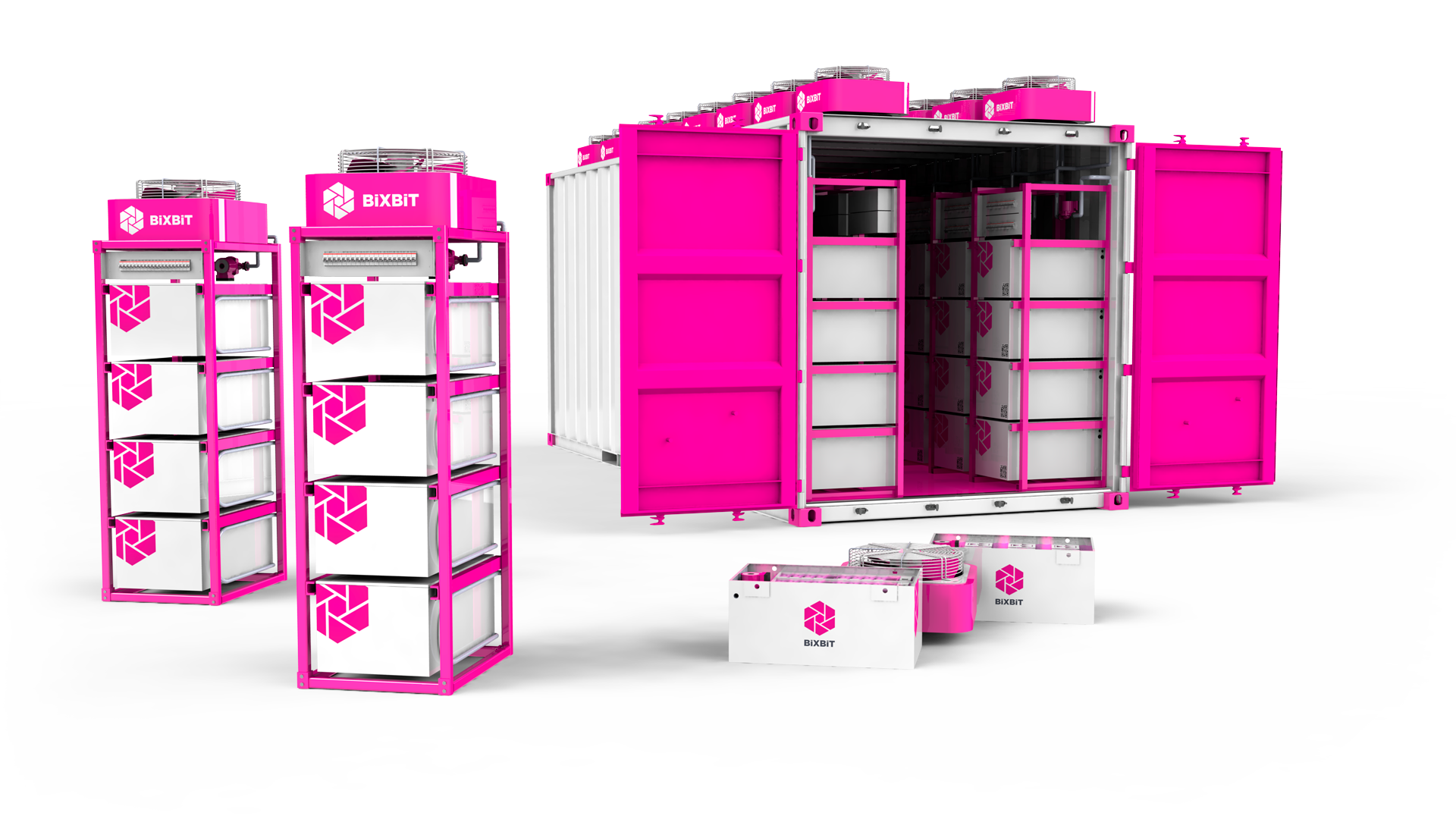
BiXBiT has made a lot of research and is ready to present its own way of cooling — a complex solution for mining equipment placement, based on the impressive cooling system. Such an approach allows us to solve the main problems of the mining industry.
Immersion cooling is a thermal management technique where hardware is submerged in a non-conductive, dielectric liquid to absorb and carry away heat directly from components. This method replaces air conditioning with a completely silent, dust-free setup with massive heat transfer efficiency.
The thermal conductivity of the liquid is 25 times higher than in case of air cooling, which significantly increases the degree of thermal stability within the installation. Due to this, the equipment lifespan increases and corresponds to the time declared by the manufacturer (and in some cases exceeds).
For example, a processor’s temperature at full power usually reaches 85 ºC, at an ambient temperature of 32 ° C. If we immerse the processor into the liquid, its average temperature will be about 65 ºC under the same conditions. Such a high degree of thermal stability and heat conductivity allows it to exceed the maximum power of the equipment, which will increase its productivity by 20–40%, depending on the tasks assigned.
Immersive liquid eliminates the key problems of the equipment failure: temperature drops due to the unevenly cooled air supply and overheating. Also, using the liquid makes dust accumulation impossible. One more advantage of immersive liquid is a high density of the equipment placement. A standard 10-foot ISO-container can fit 2.5 times more ASICs and 6 times more GPUs than when using air-conditioning. You don’t need to install extra ventilation and a professional cooling system, create cold and hot air-corridors, you save lots of space that can be used for equipment placement. Also, since you don’t need all this extra conditioning, it significantly reduces electricity consumption, which saves over 20% of previous expenditures.
For example, using 192 ASIC devices, with a cooler power consumption of 70W, will save almost 10,000 kWh per month when using the BiXBiT solution, based on the immersive cooling system, instead of a common air-cooling system. Moreover, BiXBiT installations work noiselessly, thanks to eliminating the regular cooling systems of devices.
Overseeing the current market situation, we can see that there is no better alternative to immersive system cooling according to price-to-quality ratio. As a result, the BiXBiT approach to equipment cooling allows to reduce electricity consumption, exceed the lifespan of the equipment, and increases its productivity. By the way, immersive cooling is safe, noiseless, eco-friendly and does not require special maintenance or frequent replacement.
To help you better understand the differences between the two cooling methods, here is a comparison table summarizing the key metrics discussed.
|
Metric |
Air Cooling |
Immersion Cooling (BiXBiT) |
|
Heat Transfer Efficiency |
Baseline (Air) |
25x higher (Liquid) |
|
Thermal Stability |
Low (Hot spots/unstable) |
High (Uniform distribution) |
|
Hardware Lifespan |
Standard/Reduced by heat |
Extended (up to/exceeds specs) |
|
Noise Level |
Very High (75dB+ per unit) |
Noiseless |
|
Equipment Density |
Standard |
2.5x - 6x higher density |
|
Dust Protection |
None (Risk of static failure) |
100% (Isolated from air) |
|
Overclocking Potential |
Minimal |
High (20–40% increase) |
|
Maintenance |
Frequent (Filters, fans, AC) |
Minimal |
For your crypto mining operations, immersion cooling is the better choice in the following cases:
You operate at an industrial scale and electricity costs for cooling become a significant percentage of your budget.
You want to overclock and boost hashrate by 20–40% without risking hardware burnout.
You need to maximize the number of machines in a small, fixed-size space.
When your mining location is dusty and air filters are failing to protect your equipment.
In case your facility is located in an area where 75dB+ noise levels are disturbing or prohibited.
In short, air cooling is fine for small setups, but it becomes expensive and difficult to manage at scale. Immersion cooling is a more modern, efficient, and profitable alternative.
By choosing immersion, you protect your equipment from dust and heat, save money on electricity, and increase your overall production. It is a smarter, long-term investment for any serious mining operation.


