
Visiting Data Centre World Paris once again immersed us in a professional environment where the future of data centers is being shaped. The exhibition brought together engineers, equipment manufacturers, integrators, and infrastructure developers — everyone responsible for building the computing power of tomorrow. Below are our key observations, technical insights, and conclusions from two productive days.
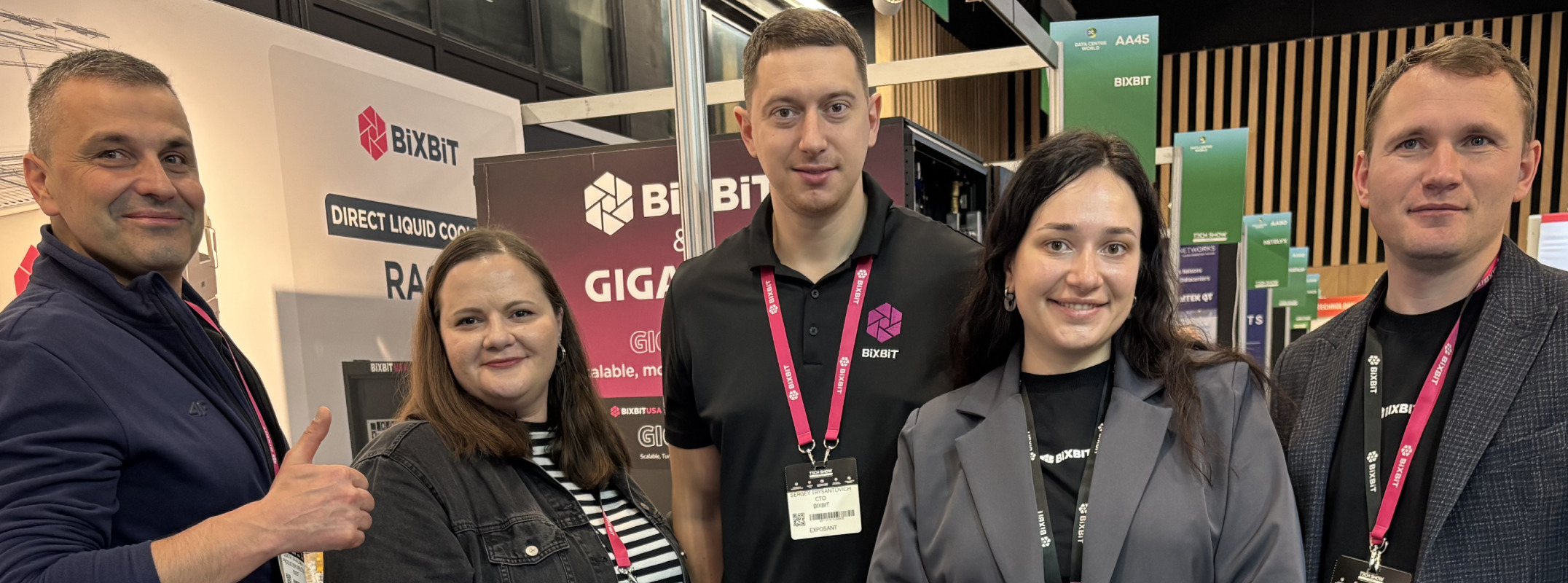
DCW Paris is one of the largest European events dedicated to infrastructure, cooling, server technologies, energy systems, and operational solutions. For us, it was:
an immersion into the current technological landscape,
an opportunity to see how industry-leading companies build their roadmaps,
a powerful networking environment for meeting new professionals and partners.
The exhibition clearly showed that the data center industry is on the verge of rapid expansion, with development strongly focused on energy efficiency, high-density computing, and accelerated modularity.
The demand for fast infrastructure deployment is growing rapidly.
The reasons are clear:
exponential growth in compute demand,
rising AI workloads,
shortage of local capacity,
the high cost and long timelines of traditional DC construction.
Modularity is no longer just a trend — it is becoming the standard for next-generation infrastructure.
The main technical direction in cooling is the shift from partially air-based systems to fully liquid-based solutions.
Expected developments toward 2026:
increased adoption of Direct Liquid Cooling,
improved efficiency of existing liquid systems,
growing interest in two-phase technologies,
rising demand for airless cooling, especially for high-density environments.
The logic is simple:
Every 1% reduction in data center energy consumption results in massive annual operational savings.
.png)
While there were no groundbreaking innovations, several directions stood out:
A strong and diverse product portfolio, systematic engineering approach, and continuous development in energy and cooling — confirming the company's leadership in the segment.
Compact and high-power UPS solutions worth testing for their density and power delivery efficiency.
An edge-oriented immersion cooling solution that caught our attention because of its simplicity:
a single integrated enclosure,
minimal preparation work,
fully adapted for outdoor deployment.
Ideal for fast-deployment scenarios where autonomy and speed are critical.
Selecting the right server hardware for specific AI models is far more complex than it may seem.
Performance depends not only on GPU and memory, but also on:
type of interconnects,
bandwidth,
cooling architecture,
workload placement model,
synchronization across nodes.
DCW Paris highlighted an approach where server selection is based on in-depth workload analysis — an expensive service, but one that provides results impossible to achieve by simply comparing specifications. It ensures the optimal architecture for specific AI processing tasks.
Fully plug-and-play solutions ready for immediate deployment.
Fast launch with minimal time and financial investment.
Power range: from a single server to full 1 MW modules.
.png)
Any configuration tailored to customer needs,
Short design and delivery cycles,
Scalable architecture for future expansion,
Cooling options: direct liquid, air, or immersion — selected based on workload.
These solutions reflect the main market trend — flexibility and rapid adaptation to AI workloads.
reliability,
energy efficiency,
environmental sustainability,
reduction of energy consumption and emissions.
The future of data centers belongs to technologies that allow resources to be used as efficiently as possible.
Data center development is a continuous technical challenge.
AI, ML, high-density workloads, and growing compute requirements push the industry to innovate faster.
What’s even more interesting:
Technologies created for data centers today will become part of everyday life tomorrow.
DCW Paris clearly confirmed:
The data center market is entering a phase of accelerated growth.
The future lies in efficient, modular, liquid-cooled solutions with a strong focus on flexibility and performance.
At BiXBiT, we are confident that these approaches will define the infrastructure standards of the next decade.


