
In 2026, choosing an ASIC for mining still starts not with hashrate, but with energy efficiency. For the B2B segment, the J/TH metric matters most because it has the strongest impact on mining cost, the stability of the financial model, and the farm’s final profitability. The market already includes models that set a new efficiency benchmark, and in this review we focus on the most interesting options for professional use.
From a cold economics perspective, the winner is not simply the fastest ASIC, but the one that delivers the highest TH/s at the lowest power draw per unit. For data center operators and mining facilities, that means lower heat load, simpler infrastructure, and more predictable payback. That is why the 2026 ranking is best built around efficiency.

This is a hydro-cooled model for large-scale farms where rack density and high hashrate per unit of space matter. With 1,160 TH/s, 9.5 J/TH, and 11,020 W, it fits sites built around liquid-cooling infrastructure and three-phase power.
It is practical when you need to increase hashrate without expanding floor space. The 3U form factor allows denser rack deployment, and liquid cooling reduces thermal load on the room. This is a working solution for data centers and industrial mining sites, not for experimental setups.
Bitmain Antminer S23 Hyd is a more compact version with the same 9.5 J/TH efficiency, but lower output: 580 TH/s at 5,510 W. That makes it easier to fit into staged farm expansion without overloading the electrical system or the water loop at once.
It is a good fit for sites that grow in blocks. The model balances power draw, performance, and placement requirements. If you need controlled scaling rather than maximum output in one point, the S23 Hyd is more practical than the 3U version.
Bitmain Antminer S23e Hyd 2U is the more space-efficient option, with 865 TH/s, 10 J/TH, and 8,650 W. It is aimed at data centers where the 2U format and standard modular layout matter.Its main advantage is size.
That makes it easier to deploy in sites where rack height, available power, or cooling layout is already constrained.
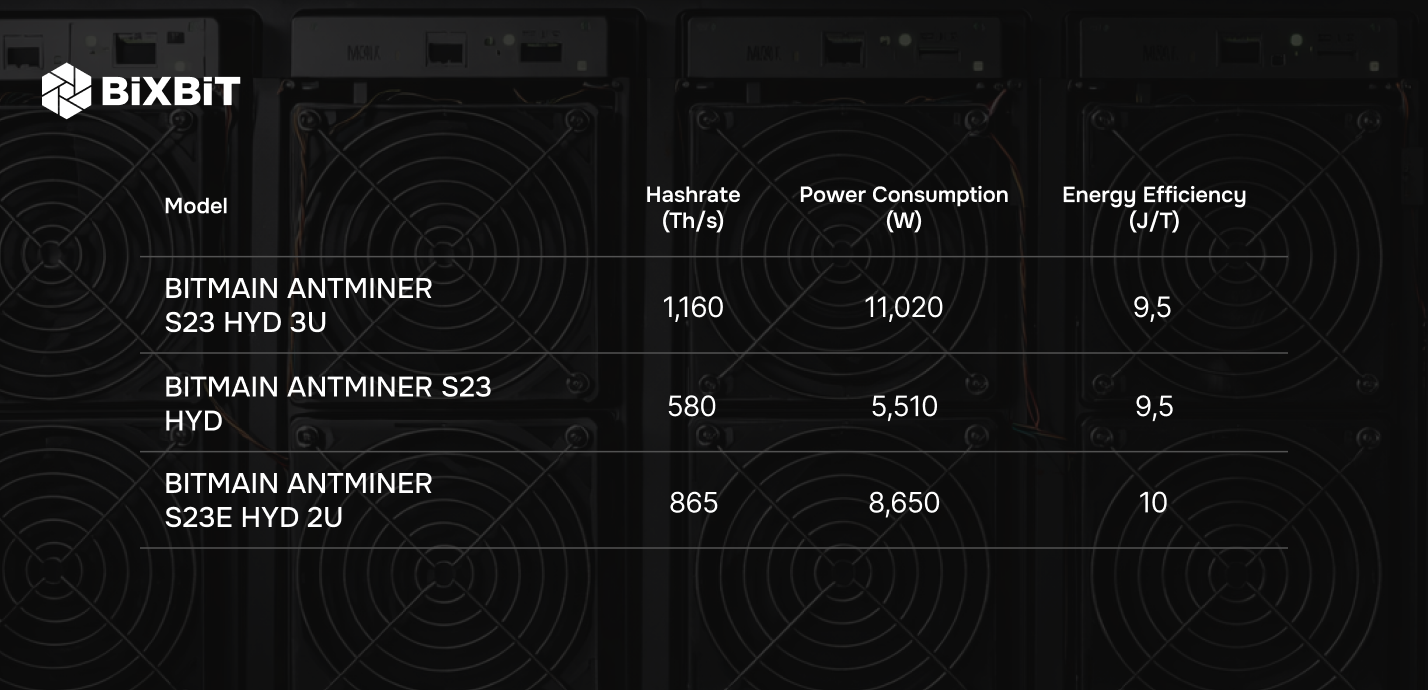
The most interesting models in the hydro segment have already approached the 9.45-10 J/TH range, and that level is becoming the new benchmark for professional farms.
For operators with mature infrastructure, this means competitive advantage will come not only from hardware purchasing, but also from proper tuning, profiling, and reducing energy costs per TH/s. In this model, firmware and software become economically significant tools, not just support layers.
To improve fleet efficiency and unlock additional ASIC management options, download BiXBiT firmware for Antminer and Whatsminer. We’re offering custom firmware solutions that help reduce power consumption and increase performance, while also providing remote management AMS monitoring.


